After a storm, stay off the roof, stop any water coming in, and photograph what you can see safely. Then get the whole roof inspected, because wind and hail damage often doesn’t leak right away. Call your insurance company if you plan to file a claim, and be careful who you hire: storm damage brings out contractors who won’t be here when the roof fails later.
Our part of the country gets a little of everything: nor’easters in the cold months, severe thunderstorms in summer, the occasional hailstorm, and the remains of hurricanes in late summer and fall. Each one damages a roof in its own way, and each leaves its own clues. Here’s what we look for after a storm across Chester, Delaware, Montgomery, and Bucks Counties and northern Delaware, and what we’d tell a neighbor to do.
Our storm seasons
Nor’easters, roughly October through April
Nor’easters are long storms. Instead of a few minutes of extreme wind, a roof takes hours of steady gusts and wind-driven rain, or heavy, wet snow. In March 2018 the region was hit by four nor’easters in a single month, and the downed trees and power outages lasted for days in places like Havertown. Winter nor’easters also set up ice dams, so the leak sometimes shows up days after the storm, when the snow starts to melt.
Severe thunderstorms, mostly June through August
Philadelphia averages roughly 27 thunderstorm days a year, and July, June, and August are the busiest months. The danger to a roof is the sudden burst of straight-line wind at the front of a storm, which can peel shingles, drop limbs, and push rain sideways under flashing.
Hail, now and then
Hail here is less frequent than in the Plains, but it happens, most often in late spring and early summer. Hail that leaves the yard looking fine can still bruise shingles and knock off their granules, especially on an older roof. That damage rarely leaks right away, which is why it’s easy to miss.
Hurricane remnants, late summer and fall
By the time tropical systems reach us they’ve usually weakened, but they still bring flooding rain, gusty wind, and tornadoes. On August 4, 2020, the remains of Isaias produced an EF2 tornado from Northeast Philadelphia to Doylestown with winds near 115 mph, and another EF2 that tracked from Dover into New Castle County. On September 1, 2021, Ida’s remnants spawned an EF2 tornado with winds near 130 mph from Fort Washington to Horsham, along with severe flooding.
What storm damage looks like
Wind
Wind catches the edge of a shingle and breaks the seal that holds it to the course below. Once that seal is broken, the shingle can lift, crease across the top, or tear off completely. A lifted or creased shingle that’s still in place can leak just like a missing one, because water gets underneath it. Wind also loosens ridge caps and pulls flashing away from walls and chimneys.
Hail
Hail knocks granules off the shingle and bruises the mat underneath. From the ground you may see nothing at all. Up close, there are dark spots where granules are missing, and the shingle feels soft when pressed. The roof often keeps working for a while, then wears out years early in those spots.
Falling trees and limbs
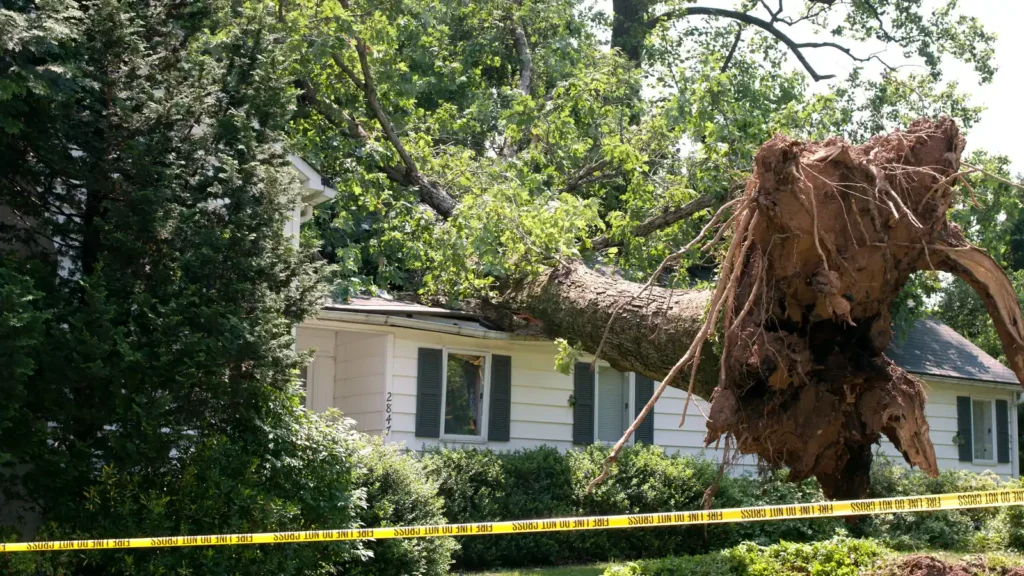
A large limb can crack the deck, break rafters, and puncture the roof outright. Even a smaller branch scraping across the shingles in the wind can strip granules and tear tabs.
Wind-driven rain and ice
Rain pushed sideways finds its way under flashing at chimneys, skylights, and sidewalls, and in winter, meltwater backed up behind ice dams works its way under the shingles at the eaves. This kind of damage often shows up inside first, as a stain on a ceiling or a damp spot along an exterior wall.
The first 24 hours after a storm
- Stay safe. Stay off the roof and away from downed power lines; report those to your utility. If a tree is resting on the house, keep out of the rooms under it.
- Stop the water you can reach. Move furniture, electronics, and valuables away from leaks, put buckets under drips, and if a ceiling is bulging with water, keep clear of it.
- Photograph everything you can see safely, from the ground and from inside: the roof, the yard, the gutters, ceilings, and walls. Note the date and time of the storm.
- Keep what came off the roof. Shingle pieces, broken vent caps, and hail-dented gutter sections all help document what happened.
- Get the roof covered if it’s open. Most homeowners policies expect you to take reasonable steps to prevent further damage, so a tarp or temporary seal shouldn’t wait for the claim. Keep the receipts.
- Call your insurance company if you plan to file a claim, and ask what they need from you.
If water is coming in, we’ll cover or temporarily seal the roof first and inspect afterward. Every hour of rain through an opening makes the damage inside bigger.
How to check your roof from the ground
You can learn a lot without a ladder. Walk all the way around the house, and use binoculars if you have them:
- Missing shingles, or shingles that look lifted, creased, or out of line with the rows around them.
- Shingle pieces, nails, or granules in the yard, the gutters, or at the bottom of downspouts.
- Dented gutters, downspouts, or metal vents, which point to hail even when the shingles look fine.
- Ridge caps that are loose or missing at the peak.
- Flashing pulled away from a chimney, a skylight, or the wall where a lower roof meets a second story.
- Inside, stains on ceilings or along exterior walls, and in the attic, damp insulation or wet spots on the underside of the deck.
If you find any of that, or if the storm was strong enough that neighbors are finding damage, have the roof inspected. We check every slope, not just the side that faced the wind.
How insurance fits in
Whether your policy covers storm damage depends on the policy, what caused the damage, and your deductible. Your insurance company is the one to answer that, so call them first and read what your policy says about wind and hail.
What we can do is give you clear evidence: photos of every bit of damage we find and a written scope of the repair or replacement, line by line. Those are yours to keep and to share with your insurer if you file a claim.
What we don’t do is negotiate your claim. In Pennsylvania, negotiating a claim on a policyholder’s behalf takes a public adjuster license, so be cautious of any contractor who offers to “handle your insurance” or promises a bigger settlement. If you want someone to represent you with your insurer, a licensed public adjuster is the person to call.
Watch out for storm chasers
After a big storm, crews from out of the area knock on doors and put signs in yards. Some do fine work. Many are gone before a problem shows up, and a roof warranty is only as good as the company standing behind it. Before you sign with anyone:
- Check the registration. Pennsylvania contractors must register with the Attorney General and put their PA HIC number on contracts, estimates, and ads. Look it up through the Pennsylvania Attorney General’s home improvement contractor registration page.
- In Delaware, ask for the license. Contractors working in unincorporated New Castle County need a county contractor license as well as a State of Delaware business license.
- Ask for a local address and references from nearby homes. A company that works here year-round has a reason to stand behind its work.
- Don’t sign on the spot. Pennsylvania gives you three business days after signing a home improvement contract to cancel without penalty, and the cancellation doesn’t have to be in writing.
- Don’t pay much up front. Pennsylvania generally limits deposits to one-third of the contract price plus special-order materials, and no payment is due before you’ve signed a written contract.
- Get the scope in writing. It should list the materials, the work, and the price, so you can compare it with any other bid.
Repair or replace after a storm?
Not every storm means a new roof. If the damage is in one area and the rest of the roof is sound, a repair is the right answer: we replace the damaged shingles, flashing, or vents and match them to your roof as closely as the product allows.
Replacement makes more sense when the damage runs across several slopes, when hail has bruised shingles all over the roof, or when the roof was already near the end of its life. In those cases, patching storm damage onto a worn-out roof usually just means paying for it twice. Either way, we’ll show you the photos and explain the recommendation. Read more about storm damage roof repair.
Getting your roof ready before the next storm
Most storm damage starts at a weak spot that was already there. A little attention between storms goes a long way:
- Trim branches that hang over the roof. Limbs that brush the shingles wear them down in every wind, and dead branches are the first to come down in a storm.
- Clean the gutters and valleys in late fall, after the leaves drop. Clogged gutters overflow in summer storms and set up ice dams in winter.
- Look at the roof from the ground each spring and fall. Missing shingles, loose flashing, or a cracked pipe collar are small repairs before a storm and big ones after.
- Take dated photos of your roof while it’s in good shape. If you ever file a claim, a before picture helps show what the storm changed.
- Know your policy. Check your deductible and whether your policy treats wind or hail differently, before you need to use it.
If your roof is getting older, a free inspection before storm season tells you where the weak spots are while there’s still time to fix them on your schedule.
Questions homeowners ask
Should I have my roof inspected after every storm?
After strong wind or hail, yes, even when the roof looks fine from the ground. Wind-lifted shingles and hail bruising are hard to see from the yard and often don’t leak right away. Our inspections are free.
How soon after a storm should I call?
Right away if water is coming in. Otherwise, within a few days is ideal, while the damage is fresh and before the next storm finds the weak spots. Insurance policies also have deadlines for reporting damage, so check yours.
Can you tarp my roof before the insurance adjuster comes?
Yes. Covering an open roof to stop more water from getting in is the first thing to do. Take your own photos first if you can do it safely, and we photograph the opening when we cover it, so there’s a record of what was there.
Will a few missing shingles lead to a bigger problem?
Often, yes. The shingles around a missing one have usually lost their seal too, and the next wind lifts them. Water also gets to the underlayment and deck. A small repair now is almost always cheaper than the damage it prevents.
Do you handle insurance claims?
We document the damage with photos and a written scope you can share with your insurer, but the claim itself is between you and your insurance company. We don’t negotiate claims.